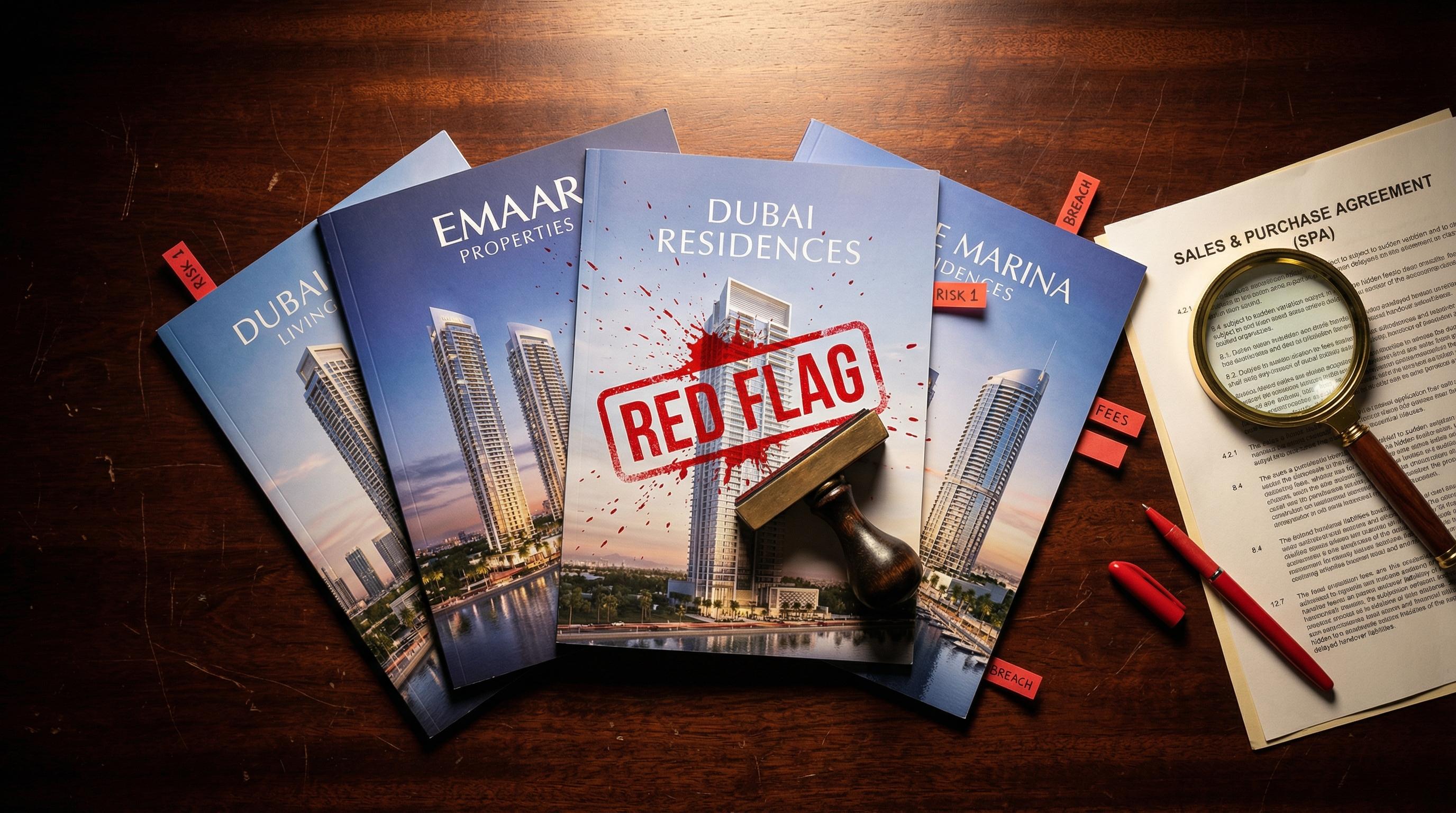
We Reviewed 50 Dubai Property Deals This Month | Here Are the 7 Red Flags We Keep Seeing

Every month, investors walk into our office — or call us from London, Mumbai, New York — with deals they've found online or been pitched by another brokerage.
"Is this a good deal?" That's the question.
Most of the time, the answer is "it depends." But sometimes the answer is "absolutely not." And the investor had no idea, because the red flags were buried in details nobody pointed out.
In March 2026 alone, our advisory team reviewed over 50 property deals brought to us by clients. These ranged from AED 500,000 studios to AED 15 million villas. Off-plan and ready. JVC to Palm Jumeirah. First-time buyers to seasoned portfolio holders.
The same red flags kept showing up. Seven of them appeared so frequently that we decided to publish them. Because if this many investors are falling for the same traps, you might be about to fall for one too.
Red flag 1: The "8% guaranteed return" that isn't guaranteed
This one shows up in at least half of the off-plan pitches we review.

A developer advertises an 8 percent guaranteed rental return for two or three years. It sounds like free money. But here's what actually happens.
The guaranteed return is already baked into the price. The developer inflates the unit price by 15 to 20 percent above market value, then pays you "rental income" from that markup. You're essentially getting your own overpayment back in installments.
When the guarantee period ends, you're left with a property that cost more than comparable units in the same area, generating market-rate rent that produces a much lower yield on your inflated purchase price.
We've seen units in Business Bay priced at AED 1.8 million with a 3-year 8 percent guarantee when identical units in the same building were reselling at AED 1.5 million. That AED 300,000 premium funds your "guaranteed" return. After year three, your actual yield on AED 1.8 million is closer to 5 percent — not 8.
What to do instead: Compare the unit price to actual recent transactions in the same building or community on DXBInteract. If the guaranteed return unit costs significantly more, you know where the "guarantee" is coming from.
Red flag 2: Service charges hidden until after you've signed
Every property in Dubai has service charges. They range from AED 8 per square foot in basic communities to AED 35 or more in premium towers with concierge, pools, and resort-style amenities.
On a 1,000 square foot apartment, the difference between AED 12 and AED 30 per square foot is AED 18,000 per year. That's a massive hit to your net yield that many buyers never calculate until after they've signed.
As we explained in our rental yields analysis, service charges are the single biggest cost that turns a great gross yield into a mediocre net yield.
We reviewed a deal last month where an investor was buying a one-bedroom in a new tower in Downtown for AED 2.1 million. The agent quoted a projected rental yield of 6.5 percent. But the service charges were AED 28 per square foot — AED 22,400 per year on a 800 square foot unit. After service charges, maintenance, and vacancy, the net yield dropped to 3.8 percent. The investor had no idea because nobody showed him the service charge schedule.
What to do instead: Ask for the official service charge rate before signing anything. If the building is new and doesn't have a confirmed rate yet, look at the developer's other completed projects in the same tier — that gives you a reliable estimate.
Red flag 3: Off-plan from developers with no delivery track record
Dubai's off-plan market is booming. Hundreds of new projects launch every month. And not every developer has the financial strength or operational capability to deliver on time — or at all.
We reviewed deals from at least six developers in March who had zero completed projects in their portfolio. They had beautiful brochures, slick websites, and aggressive payment plans. But no finished buildings.
RERA's escrow system protects your payments — your money goes into a regulated account, not the developer's pocket. But escrow doesn't protect you from delays. A project that's supposed to hand over in 2028 could easily push to 2030 or beyond if the developer runs into financial trouble, contractor disputes, or regulatory issues.
Meanwhile, your capital is locked. You're making installment payments on something that doesn't exist yet. And you can't earn rental income until handover.
What to do instead: Check the developer's track record. How many projects have they delivered? Were they on time? Visit completed projects and talk to residents. If the developer has never delivered a single building, proceed with extreme caution — no matter how attractive the payment plan looks.
Red flag 4: The location that looks central on a map but isn't in reality

Maps lie. Or rather, maps don't show you traffic, construction, noise, or the actual experience of living somewhere.
We reviewed a deal in Al Furjan where the broker pitched it as "minutes from Sheikh Zayed Road and close to everything." On paper, sure. In reality, the access roads were under construction, the nearest supermarket was a 10-minute drive, and the area had no pedestrian walkability whatsoever.
We reviewed another deal in a new tower near Dubai Creek. The marketing showed the Creek Tower in the background, suggesting proximity to the iconic landmark. The actual distance was over 4 kilometers — but the rendering angle made it look like the tower was next door.
What to do instead: Visit the property. Walk the neighborhood. Drive the commute during rush hour. Open Google Maps Street View. Ask existing tenants what it's actually like to live there. No brochure replaces physical due diligence.
Red flag 5: Payment plans designed to trap, not help
Post-handover payment plans are one of the best innovations in Dubai real estate. They let you spread your cost over years, reducing upfront capital requirements.
But some payment plans are structured in ways that create serious problems.
We reviewed a 60/40 plan where 60 percent was due during construction and 40 percent at handover. The buyer had budgeted for the construction payments but hadn't arranged the handover payment. When handover arrived, they couldn't make the 40 percent lump sum. The developer enforced penalties. The buyer almost lost the property.
We reviewed another plan where the monthly installments were manageable, but a massive balloon payment of 30 percent was due at completion — hidden in the fine print of the SPA.
What to do instead: Read every page of the SPA payment schedule. Map every single payment to your cash flow calendar. If there's a large balloon payment at the end, make sure you have a clear plan to cover it — whether from savings, a mortgage, or a sale. If you can't explain exactly how you'll make every payment, don't sign.
Red flag 6: Buying in an oversupply zone without knowing it
This red flag connects directly to the research we published on Dubai's 130,000-unit supply pipeline.
Nearly 45 percent of all under-construction supply is concentrated in just five areas: JVC, Dubai South, MBR City, Business Bay, and DLRC. And 86 percent of the pipeline is apartments — specifically studios and one-bedrooms.
We reviewed multiple studio deals in JVC and Arjan where the investor had no idea that thousands of identical units were being built in the same community. They were buying based on current rental demand without factoring in what happens when supply doubles.
A studio in JVC generating AED 38,000 in rent today might generate AED 32,000 in 2028 when 16,000 new units compete for the same tenant pool. That's an 16 percent drop in income that nobody warned the buyer about.
What to do instead: Before buying in any area, check the supply pipeline. Ask how many units are under construction in that community. Compare to the existing inventory. If the new supply represents more than 15 to 20 percent of the current stock, factor in potential rent compression.
Red flag 7: Ignoring exit strategy entirely
This is the most dangerous red flag of all because it's invisible until you need to sell.
Every investor we spoke to in March had a buying plan. Almost none had a selling plan.
"What's your exit strategy?" is a question most brokerages never ask, because their job is to sell you the property — not to help you sell it later.
But exit strategy determines everything. If you buy a studio in an oversupplied community with no distinguishing features, your exit pool is tiny — you're competing with hundreds of identical listings. If you buy a villa in a supply-constrained area with strong end-user demand, your exit pool is deep and your pricing power is strong.
We reviewed a deal where an investor bought three off-plan studios in the same building, planning to flip at handover. But by handover, 200 other investors in the same building had the same plan. The resale market was flooded with identical units, prices stagnated, and the investor couldn't exit without a loss.
What to do instead: Before you buy, answer three questions. Who will buy this from me when I want to sell? Will there be fewer or more competing listings at that time? And what is my plan if the market softens before I want to exit?

The bottom line
Dubai is one of the best real estate markets in the world. We wouldn't be in this business if we didn't believe that. But "best market" doesn't mean "every deal is good."
The red flags we see every month aren't rare. They're in at least 30 percent of the deals investors bring to us. And they're almost always avoidable — if someone takes the time to show you what to look for.
That's what we do at RnD Realty. We don't just find you a property. We tell you when to walk away.
If you've been pitched a deal and want an honest second opinion — no sales pressure, no obligation — send it to us. We'll review it within 24 hours and tell you what we'd tell our own family.
Data sources: DXBInteract, Dubai Land Department, RERA, Khaleej Times, Cavendish Maxwell.
FAQ
Q: What are the biggest red flags when buying property in Dubai? A: The most common red flags include inflated guaranteed rental returns, hidden service charges, buying from developers with no delivery track record, misleading location marketing, payment plans with hidden balloon payments, purchasing in oversupplied areas, and having no exit strategy.
Q: Are guaranteed rental returns in Dubai real? A: Guaranteed returns exist, but they're typically funded by inflating the purchase price 15-20% above market value. The developer pays you back your own overpayment as "rent." When the guarantee period ends, your yield based on the inflated price is usually much lower than advertised.
Q: How can I check if a Dubai developer is reliable? A: Check their completed project portfolio on the Dubai Land Department website. Visit their finished buildings in person. Read reviews from existing residents. Check RERA registration. If a developer has zero completed projects, proceed with extreme caution regardless of their marketing quality.
Q: What service charges should I expect in Dubai? A: Service charges range from AED 8-12 per square foot in basic communities like International City, AED 14-18 in mid-market areas like JVC and JLT, and AED 20-35+ in premium buildings in Downtown, Marina, and Palm Jumeirah. Always request the official rate before purchasing.
Q: How important is an exit strategy for Dubai property? A: Exit strategy is critical. Before buying, determine who your future buyer will be, how many competing listings will exist when you want to sell, and what you'll do if the market softens. Properties with unique features in supply-constrained areas offer the strongest exit options.
Related Posts
 Apr 21, 2026
The 80% Signal: What Dubai's April Data Tells Smart Investors
Off-plan just crossed 80% of Dubai apartment transactions in April 2026. Median price held at AED 1,...
 Apr 07, 2026
Palm Jebel Ali: Dubai's AED 35 Billion Mega Island Is Back| Should You Buy Now or Wait?
Palm Jebel Ali is twice the size of Palm Jumeirah, 60% cheaper per sqft, and already AED 35 billion...
 Apr 01, 2026
Priced Out of Dubai? 7 Areas Where You Can Still Buy Under AED 1 Million in 2026
Think you can't afford Dubai property? These 7 areas still offer apartments and townhouses under AED...