Priced Out of Dubai? 7 Areas Where You Can Still Buy Under AED 1 Million in 2026
Let's have an honest conversation.
The average apartment price in Dubai just hit AED 1,770 per square foot. That's a 14% jump from last year. Palm Jumeirah is selling apartments at AED 90 million. Aman Residences just closed a deal at AED 55 million. And if you've been browsing Downtown or Marina listings, you already know — anything decent starts north of AED 2 million.
So the question a lot of first-time buyers and overseas investors are asking right now is simple: can I still buy in Dubai if my budget is under AED 1 million?
The answer is yes. But you need to know exactly where to look. And more importantly, where not to look.
Because not all affordable areas are created equal. Some are genuinely undervalued with strong fundamentals. Others are cheap for a reason — and they're about to get cheaper when 130,000 new units flood the market over the next two years.
Here are seven areas where your money still goes a long way. Every price, every yield figure, and every risk factor is real.

1. International City — The entry point
Starting price for a studio: AED 280,000 to AED 350,000. One-bedroom apartments: AED 400,000 to AED 550,000.
International City has always been Dubai's most affordable large-scale residential community. It was built for budget-conscious tenants and it still serves that function. What's changed is the infrastructure story. The Dubai Metro Blue Line will have three stations serving International City, including what will be the world's largest underground metro station at 44,000 square metres. That station alone is designed for 350,000 passengers per day.
Rental yields here run between 8% and 9.5%, which are among the highest in Dubai. The tenant base is stable — working professionals, families, and students from nearby Academic City.
The honest risk: International City has significant new supply coming. Studios and one-bedrooms dominate the pipeline, which means competition for tenants will increase. If you buy here, buy for yield and hold for the Blue Line to open in 2029. Don't expect fast capital appreciation in the next 12 months.
2. Dubai Silicon Oasis (DSO) — The tech corridor
One-bedroom apartments: AED 450,000 to AED 650,000. Two-bedrooms: AED 700,000 to AED 950,000.
DSO is home to 88,000 residents and a growing technology ecosystem. It has its own free zone, which attracts startups and tech companies, creating a built-in tenant base of professionals who work where they live. Rental yields sit between 7.5% and 8.5%.
The Metro Blue Line will give DSO its first direct metro connection. Historically, communities that gain metro access see property values rise 10-15% within the first two years of operations. That window is still open — the station opens in 2029, and prices haven't fully priced in the connectivity upgrade yet.
The honest risk: DSO is established enough that oversupply isn't a major concern, but it's not a glamorous address. Resale liquidity can be slower than in more central areas. This is a yield play, not a lifestyle play.
3. Jumeirah Village Circle (JVC) — The volume leader
Studios: AED 400,000 to AED 550,000. One-bedrooms: AED 600,000 to AED 850,000.
JVC is the most active mid-market area in Dubai. It consistently leads transaction volumes and offers rental yields of 7% to 8.5%. It's well-connected, reasonably priced, and has developed into a genuine community with parks, schools, and retail.
But here's the part nobody tells you: JVC has approximately 16,852 new units coming through 2027. That's the highest supply pipeline of any single area in Dubai. We wrote about this in detail in our supply analysis.
The honest risk: JVC is not a bad investment. It's a crowded one. If you buy in JVC, you need to be selective. Choose a unit with a distinguishing feature — a garden view, a larger layout, a premium developer. The generic studios that look identical to 5,000 other studios in the same community will face the most pressure when supply peaks.
4. Dubai South — The airport play
Studios: AED 350,000 to AED 500,000. One-bedrooms: AED 500,000 to AED 750,000.
Dubai South is the master-planned city being built around Al Maktoum International Airport, which is set to become the world's largest airport. The Expo 2020 legacy site, District 2020, is here. The logistics infrastructure is expanding. And the government has made it clear — this is where Dubai's next phase of growth will happen.
Prices are low because the area is still developing. Amenities are limited. Commute times to central Dubai are long. But that's exactly why it's affordable. And for investors with a 5-10 year horizon, the upside is significant.
Rental yields currently range from 7% to 8%. As the airport expansion progresses and more companies establish operations in the area, tenant demand will grow.
The honest risk: This is a patience play. If you need rental income tomorrow from a fully established community, Dubai South isn't there yet. If you're thinking about where Dubai will be in 2030, this is one of the most compelling bets at current prices.
5. Dubailand Residence Complex (DLRC) — The Blue Line bet
One-bedrooms: AED 500,000 to AED 700,000. Two-bedrooms: AED 700,000 to AED 950,000.
DLRC sits within Dubailand and is positioned about 5 minutes from the upcoming Metro Blue Line route. It offers more space per dirham than almost anywhere in Dubai — one-bedrooms here are 20-25% larger than equivalent units in JVC or Arjan.
Rental yields are strong at 7.5% to 8.5%, and the area attracts families who want affordable space near schools in Academic City.
The honest risk: DLRC is still building its identity. It lacks the walkable retail and dining that more established communities offer. The Blue Line will help enormously, but that's three years away. Buy here if you're comfortable holding through the development phase.
6. Al Furjan — The family-friendly option
Townhouses: AED 800,000 to AED 1.2 million (some under AED 1 million). Apartments: AED 500,000 to AED 750,000.
Al Furjan is one of the few areas where you can buy a townhouse-style property close to AED 1 million. It's master-planned with parks, schools, a community centre, and excellent road connectivity to Sheikh Zayed Road and Mohammed Bin Zayed Road. The Ibn Battuta Metro station (Red Line) is nearby.
The villa and townhouse segment in Dubai faces zero oversupply risk — 86% of the upcoming supply pipeline is apartments. That means townhouse values in Al Furjan are structurally protected.
Rental yields for townhouses run between 6% and 7%, which is lower than apartment yields, but capital appreciation potential is stronger because supply is limited.
The honest risk: Al Furjan apartments face moderate supply pressure from nearby communities. But the townhouse segment is the play here. If you can stretch your budget to AED 1 million for a townhouse, you're buying into the segment of the market with the best supply-demand dynamics in all of Dubai.
7. Arjan — The emerging mid-market
Studios: AED 380,000 to AED 500,000. One-bedrooms: AED 550,000 to AED 750,000.
Arjan sits along Al Barsha South, close to Miracle Garden and Butterfly Garden, with good road connectivity. It's attracted a wave of new developments from mid-market developers, and rental yields range from 7% to 8%.
The area is developing quickly. New retail, F&B, and community amenities are being built. For buyers who want something newer than International City but cheaper than JVC, Arjan fits the gap.
The honest risk: Arjan has a lot of new supply coming, particularly studios and one-bedrooms. The same warning applies as JVC — buy selectively. Larger units (two-bedrooms) and units with balconies or views will outperform the generic stock.
The real question: should you even buy under AED 1 million?
Here's what we tell clients at RnD Realty when they come to us with a budget under AED 1 million.
If your goal is rental yield and passive income — yes, absolutely. Areas like International City, DSO, and Dubai South offer some of the highest yields in any major global city. A studio generating 8-9% gross yield in a tax-free environment is a financial instrument that doesn't exist in London, Singapore, or New York at this price point.
If your goal is capital appreciation — be more careful. The affordable segment is where supply is heaviest. Studios and one-bedrooms make up 66% of the entire upcoming pipeline. Price growth will be slower in oversupplied areas, and some may even soften temporarily as new units are delivered.
If your goal is to live in the property — focus on community quality over price per square foot. A slightly more expensive unit in a better-established community with schools, retail, and transport connectivity will serve you better long-term than the cheapest possible unit in a developing area.
Whatever your goal, the worst thing you can do is buy based on an Instagram ad. The best thing you can do is look at the data, understand the supply dynamics, and make a decision that matches your timeline.
That's what we're here for.
If you want an honest assessment of any property in Dubai — including the ones we'd tell you to avoid — contact our advisory team. We don't sell listings. We build strategies.
Data sources: DXBInteract, Dubai Land Department, Cushman & Wakefield, Khaleej Times, Property Finder, CBRE.
FAQ's
Q: Can I buy property in Dubai under AED 1 million? A: Yes. Areas like International City, Dubai Silicon Oasis, JVC, Dubai South, DLRC, Al Furjan, and Arjan offer studios and one-bedroom apartments starting from AED 280,000. Townhouses in Al Furjan are available close to AED 1 million.
Q: What is the best area to buy affordable property in Dubai in 2026? A: For rental yield, International City and DSO offer 8-9.5%. For long-term capital appreciation, Dubai South and DLRC offer the best upside tied to infrastructure development. For a balance of yield and lifestyle, JVC remains the most active market.
Q: What rental yields can I expect from budget Dubai property? A: Affordable areas in Dubai typically offer gross rental yields of 7% to 9.5%, significantly higher than comparable global cities. International City leads with yields up to 9.5%, followed by DSO at 7.5-8.5% and JVC at 7-8.5%.
Q: Is it safe to buy cheap property in Dubai? A: Affordable doesn't mean risky, but you need to be selective. Areas with heavy upcoming supply (especially studios in JVC and Arjan) may face temporary pressure. Buy from reputable developers, choose units with distinguishing features, and match your investment to a realistic timeline.
Q: Can I get a Golden Visa by buying property under AED 1 million? A: The Golden Visa requires a minimum property investment of AED 2 million. However, purchasing under AED 1 million qualifies for a 2-year investor visa in certain cases. For a 10-year Golden Visa, you would need to invest in a higher-value property or combine multiple properties.
Related Posts
 Apr 21, 2026
The 80% Signal: What Dubai's April Data Tells Smart Investors
Off-plan just crossed 80% of Dubai apartment transactions in April 2026. Median price held at AED 1,...
 Apr 07, 2026
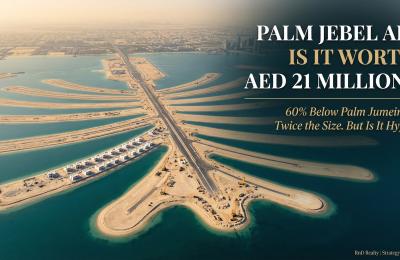
Palm Jebel Ali: Dubai's AED 35 Billion Mega Island Is Back| Should You Buy Now or Wait?
Palm Jebel Ali is twice the size of Palm Jumeirah, 60% cheaper per sqft, and already AED 35 billion...
 Apr 07, 2026
We Reviewed 50 Dubai Property Deals This Month | Here Are the 7 Red Flags We Keep Seeing
Our advisory team reviewed 50 property deals brought to us by investors in March 2026. These are the...