
100,000 Units Are Coming to Dubai — Which Areas Will Crash and Which Will Survive

Everyone in Dubai real estate is telling you to buy. The market is strong. Transactions are up. Ramadan just did AED 50 billion. All true.
But nobody is talking about what happens when 130,000 new residential units show up at the door between now and the end of 2027.
We will.
Because at RnD Realty, we'd rather lose a sale today than lose your trust forever. And the truth is, not every area in Dubai is going to survive what's coming. Some will thrive. Some will get crushed. And the difference between the two comes down to three things: location, unit type, and supply concentration.
Let's break it down.
The numbers nobody wants you to see
Here's what the data actually says, according to Cushman & Wakefield, Morgan's International Realty, and Cavendish Maxwell:
Dubai's total residential inventory stood at 935,000 units by end of 2025. In 2026 alone, around 55,000 new units are expected to be handed over. In 2027, that number jumps to approximately 75,000 — nearly double the five-year average of 35,531 units per year.
And if you zoom out further, nearly 366,000 residential units are projected to enter the market by 2028.
Now, before you panic — there's a built-in safety valve. Historically, only 48% to 62% of projected units actually get delivered on time. Construction delays, phased launches, and contractor capacity limits mean the real number will be lower.
But even at 60% delivery, that's still 33,000 new homes in 2026 and 45,000 in 2027. That's a lot of inventory hitting the market.
The critical question: where are they all going?

This is where it gets interesting — and where most people get it wrong.
The supply isn't spread evenly across Dubai. It's concentrated in a handful of areas. Nearly 45% of all under-construction stock is located in just five districts: Jumeirah Village Circle (JVC/JVT), Dubai South, MBR City, Business Bay, and Dubailand Residence Complex.
And here's the other thing nobody mentions: 86% of the upcoming pipeline is apartments. Studios and one-bedrooms make up roughly 66% of that.
This means the oversupply risk isn't a citywide problem. It's an apartment-heavy, mid-market, specific-area problem.
THE DANGER ZONES — areas facing real oversupply risk
Jumeirah Village Circle (JVC)
JVC is the volume leader for supply in Dubai. It has approximately 16,852 units scheduled across 2025-2027 — the most of any single area. In 2025 alone, about 13,900 units were delivered. Another 11,800 are planned for 2026.
JVC has great rental yields right now — 7% to 8.5% for apartments. But when thousands of identical studios and one-bedrooms flood the same community at the same time, tenants have options. Landlords compete on price. Yields compress.
Our honest take: JVC is not going to crash. It's too established, too central, and too well-connected. But if you're buying a studio in JVC purely for capital appreciation over the next 18 months, you need to understand that price growth will likely flatten. Rental yields may soften by 1-2 percentage points as tenants negotiate harder. It's a hold-and-wait situation, not a quick-flip opportunity.
Business Bay
Business Bay has over 10,000 units in the pipeline through 2027. It's already one of the densest areas in Dubai, and the sheer volume of new towers means competition for tenants will increase.
The saving grace for Business Bay is its location — walking distance to DIFC, Downtown, and the canal waterfront. Premium towers with canal views will hold up. But generic mid-rise apartments with no distinguishing features will face pressure. If your unit looks like every other unit in the building next door, expect slower rental increases and longer vacancy periods.
Dubailand Residence Complex (DLRC)
DLRC is betting heavily on the Metro Blue Line to transform its value proposition. And that bet will eventually pay off — the Blue Line opens in September 2029. But between now and then, a large volume of new units in an area that still lacks walkable amenities and retail infrastructure means absorption will be slow.
If you're buying in DLRC, you need a 3-5 year horizon minimum. Short-term investors should look elsewhere.
Dubai South
Dubai South is a long-term infrastructure play tied to Al Maktoum International Airport. Massive supply is coming here. The area makes sense for investors who understand that the real returns are 5-10 years away, tied to airport expansion and Expo legacy development. But right now, it's still a developing area with limited amenities. Large supply plus limited immediate demand equals pricing pressure in the near term.
Arjan and Al Furjan
Both areas have significant new supply coming, primarily apartments. They've benefited from the broader Dubai boom, but they don't have the locational advantages of Downtown or the metro connectivity of JVC. Oversupply risk is moderate to high in the apartment segment.
THE SAFE ZONES — areas that will hold or grow
Palm Jumeirah, Emirates Hills, Jumeirah Bay Island
Ultra-prime. Structurally undersupplied. No new land to build on. These areas don't follow supply cycles because there is no supply. Prices here rose 15% in 2025 and show no signs of correction. If you can afford it, prime waterfront and established villa communities remain the safest store of value in Dubai real estate.
Dubai Hills Estate
Family-focused, master-planned, excellent schools and retail. Villa supply is limited compared to demand. Dubai Hills has consistently outperformed the broader market because it attracts end-users, not speculators. When a community is dominated by people who actually live there, prices are more stable.
Dubai Creek Harbour
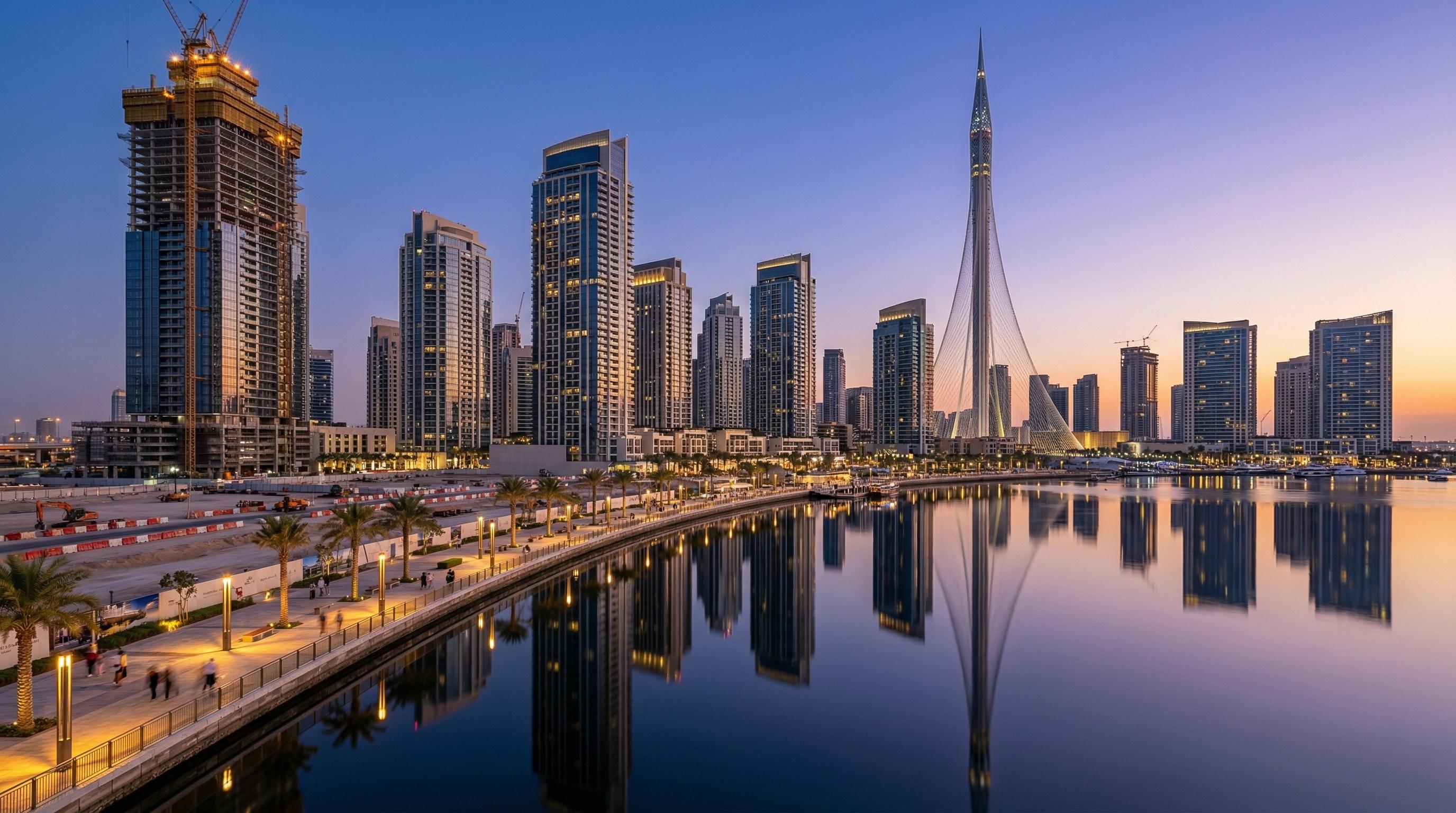
Two massive catalysts: the redesigned Creek Tower project and the Metro Blue Line station (the world's tallest metro station at 74 metres, designed by the architects behind the Burj Khalifa). Creek Harbour is transitioning from a developing area to a landmark destination. Prices have already risen 30% and are expected to continue climbing as infrastructure materializes.
Mirdif and Al Warqa
Established family communities that have been undervalued for years. The Blue Line will connect Mirdif to the rest of Dubai's metro network for the first time. Properties within walking distance of the new Mirdif station could see 10-15% price increases, according to market estimates. These areas are buy-and-hold gold for patient investors.
Villas and townhouses across the board
Here's the number that should define your strategy: 86% of the upcoming supply is apartments. Only 14% is villas and townhouses. Villas are chronically undersupplied in Dubai. Prices have more than doubled since 2020. With 15,284 villas expected in 2026 and only 5,631 in 2027, the villa market faces zero oversupply risk. If anything, the gap between villa demand and villa supply is widening.
What smart investors are doing right now
The smartest investors we work with at RnD Realty aren't panicking about supply numbers. They're using those numbers to make better decisions.
They're avoiding generic studios in oversupplied areas. They're targeting villas and townhouses where supply is structurally limited. They're looking at Blue Line corridor communities where infrastructure will create new demand. They're focusing on areas dominated by end-users rather than speculators. And they're negotiating harder on off-plan deals because developers in competitive areas are offering DLD fee waivers, flexible payment plans, and post-handover payment structures that didn't exist 12 months ago.
The supply wave isn't a crisis. It's a filter. It separates smart investments from lazy ones. And if you're reading this, you're already ahead of 90% of buyers who are still making decisions based on Instagram ads.
The bottom line
Dubai isn't going to crash. The fundamentals are too strong — 208,000 new residents added last year, 250,000 Golden Visas issued since 2021, AED 50.58 billion in transactions during Ramadan alone, and a diversified economy that doesn't depend on any single sector.
But some areas will face pressure. If you're buying an apartment in JVC, Business Bay, DLRC, or Dubai South, go in with your eyes open. Understand the supply dynamics. Negotiate accordingly. And have a realistic timeline.
If you're buying a villa, a townhouse, or anything in a structurally undersupplied prime area — the next 2-3 years could be the last window before prices move permanently higher.
That's not hype. That's the data.
At RnD Realty, we don't sell you what we have. We advise you on what makes sense. If you want an honest assessment of any Dubai property investment — including the ones we'd tell you to walk away from — contact our team.
Data sources: Cushman & Wakefield, Morgan's International Realty, Cavendish Maxwell, Dubai Land Department, Knight Frank, Fitch Ratings, Khaleej Times, Bloomberg, DXBInteract.

FAQ's
Q: Will Dubai property prices crash in 2026? A: A citywide crash is unlikely. Dubai added 208,000 new residents last year and recorded AED 50.58 billion in transactions during Ramadan 2026 alone. However, specific areas with heavy apartment supply — particularly JVC, Business Bay, and DLRC — may see price growth flatten or soften temporarily.
Q: How many new units are coming to Dubai in 2026 and 2027? A: Approximately 55,000 units are expected in 2026 and 75,000 in 2027, according to Cushman & Wakefield. However, historically only 48-62% of projected units are delivered on time due to construction delays.
Q: Which areas in Dubai have the highest oversupply risk? A: JVC leads with approximately 16,852 units in the pipeline through 2027. Business Bay has over 10,000 units coming. DLRC, Dubai South, Arjan, and Al Furjan also face elevated supply. The risk is concentrated in the apartment segment, particularly studios and one-bedrooms.
Q: Which areas in Dubai are safest to invest in 2026? A: Structurally undersupplied areas remain safest: Palm Jumeirah, Emirates Hills, Dubai Hills Estate, and Jumeirah Bay Island. Villas and townhouses across Dubai face zero oversupply risk. Areas along the upcoming Metro Blue Line — particularly Dubai Creek Harbour and Mirdif — offer strong upside.
Q: Are villas in Dubai a better investment than apartments in 2026? A: Based on supply data, yes. 86% of the upcoming pipeline is apartments, while villas represent only 14%. Villa prices have more than doubled since 2020 and supply remains structurally limited, making them more resilient to any broader market softening.
Related Posts
 Apr 21, 2026
The 80% Signal: What Dubai's April Data Tells Smart Investors
Off-plan just crossed 80% of Dubai apartment transactions in April 2026. Median price held at AED 1,...
 Apr 07, 2026
Palm Jebel Ali: Dubai's AED 35 Billion Mega Island Is Back| Should You Buy Now or Wait?
Palm Jebel Ali is twice the size of Palm Jumeirah, 60% cheaper per sqft, and already AED 35 billion...
 Apr 07, 2026
We Reviewed 50 Dubai Property Deals This Month | Here Are the 7 Red Flags We Keep Seeing
Our advisory team reviewed 50 property deals brought to us by investors in March 2026. These are the...